The mist-shrouded peaks of China's most iconic mountains have long served as backdrops for the country's beloved wuxia films—those gravity-defying tales of chivalrous swordsmen and flying warriors. Among these natural wonders, Yandang Mountain and Huangshan stand apart as living embodiments of martial arts cinema's visual poetry. These landscapes don't merely provide scenery; they breathe life into the very movements performed onscreen, their geological rhythms mirroring the ebb and flow of fictional combat styles.
Yandang's jagged basalt formations create a geological wuxia manual carved by time. The mountain's signature "Flying Stone"—a massive boulder suspended between two cliffs—inspired the death-defying leaps seen in Zhang Yimou's "Hero", where warriors appear to walk on air. Local guides still point to the Dragon Waterfall's curved plunge as the real-world counterpart to the "Drunken Dragon" sword technique, its liquid movements adapted into a fighting style requiring perfect imbalance. During autumn mornings when fog wraps the peaks like silk, one can almost glimpse the ghostly afterimages of dueling masters from "Crouching Tiger, Hidden Dragon".
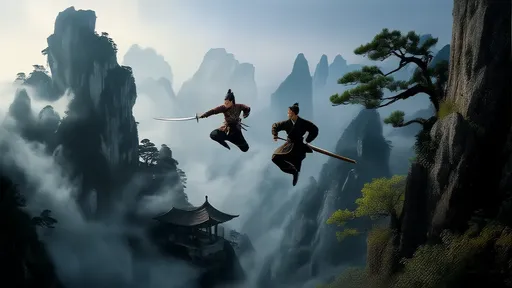
Huangshan's granite spires, often piercing through clouds like celestial swords, birthed an entire school of cinematic combat. The Beginning-to-Believe Peak's knife-edge ridges became the testing ground for wirework in "The Bride with White Hair", its vertical drops demanding a new vocabulary of aerial kicks. Pine trees growing at impossible angles taught choreographers the principle of "rooted flight"—where fighters appear simultaneously anchored and weightless. Most remarkably, the Sea of Clouds phenomenon transforms the mountaintops into islands, creating the illusion of warriors stepping between floating realms as seen in "House of Flying Daggers".
What few realize is how these locations actively shaped martial arts theory. Yandang's Echoing Wall—a natural sound amplifier—led to the development of "Sonic Palm" techniques in 1980s films, where strikes were timed to the mountain's acoustic rebounds. Huangshan's Hot Springs, steaming through cracks in winter, inspired the "Mist Veil" evasion style where fighters disappear behind geothermal vapors. Local stone carvings at Lingfeng Peak even depict medieval martial stances that later appeared in "Dragon Gate Inn", suggesting a centuries-old dialogue between landscape and combat arts.
The mountains' microseasons dictate filming possibilities. Yandang's summer thunderstorms create perfect conditions for "Rain Blade" sequences, where droplets are sliced midair—a effect achieved only during July's monsoon humidity. Huangshan's rime ice in January gives weapons an ethereal glow, as seen in the "Ice Needles" fight from "The White Haired Witch" trilogy. Cinematographers speak of the "Golden Hour"—not sunrise or sunset, but the 23-minute window when Huangshan's sea of clouds reflects amber light, creating the signature halo effects around dueling warriors.
Modern wuxia directors increasingly treat these locations as co-choreographers. For "Shadow", Zhang Yimou used Yandang's Moonlight Cave to create the "Umbrella Blades" sequence, where spinning weapons cast moving shadows like a natural zoetrope. The upcoming "Song of the Condor" reboot filmed Huangshan's West Sea Canyon at midnight to capture lunar-lit silhouettes for a new "Bat Wing" fighting style. As drone technology reveals previously inaccessible angles, these ancient mountains continue teaching filmmakers fresh visual languages—proving that the best martial arts masters may indeed be the mountains themselves.
Behind the cinematic magic lies an ecological imperative. Both UNESCO sites now enforce strict "zero footprint" filming policies after the 2000s tourism boom caused erosion. The China Film Association collaborates with park rangers to identify durable shooting locations, sometimes using 3D mapping to recreate sensitive areas digitally. This delicate balance honors what locals have always known—that these peaks are not mere sets, but living repositories of cultural memory where every crag whispers secrets of the martial arts.

By /Jul 25, 2025

By /Jul 25, 2025
By /Jul 25, 2025

By /Jul 25, 2025

By /Jul 25, 2025
By /Jul 25, 2025
By /Jul 25, 2025

By /Jul 25, 2025
By /Jul 25, 2025

By /Jul 25, 2025

By /Jul 25, 2025

By /Jul 25, 2025

By /Jul 25, 2025

By /Jul 25, 2025
By /Jul 25, 2025

By /Jul 25, 2025
By /Jul 25, 2025

By /Jul 25, 2025

By /Jul 25, 2025

By /Jul 25, 2025
