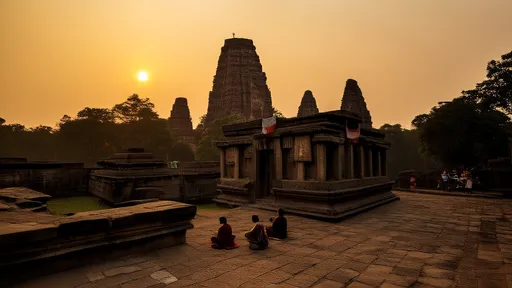
The ancient temples of Angkor Wat stand as silent witnesses to centuries of history, their spires piercing the morning mist as dawn breaks over Cambodia. For photographers and travelers alike, capturing the perfect sunrise over this iconic site has become something of a pilgrimage – a ritual that demands strategy, patience, and an intimate understanding of light and composition. The so-called "Sunrise Battle" at Angkor Wat isn’t merely about showing up early; it’s a carefully orchestrated dance between positioning, equipment, and timing that separates fleeting snapshots from transcendent imagery.
The Prelude: Understanding the Arena
Before the first hint of gold touches the horizon, Angkor Wat’s reflection pools already teem with whispers and tripod legs. The temple’s westward orientation creates a unique dynamic – the sun rises behind its iconic silhouette, casting the five lotus towers into sharp relief against a rapidly evolving sky. This celestial alignment transforms the complex into a natural amphitheater where light performs. Veteran photographers know that the "classic" shot from the left reflection pool offers more than just symmetry; it provides depth, with foreground water mirroring both the temple and the clouds above. But this prime real estate becomes fiercely contested as the hour approaches.
The Early Gambit: Securing Your Territory
Arriving before 4:30 AM during peak season often means joining a queue at the ticket checkpoint, where guards begin processing visitors precisely at 5:00 AM. From there, it becomes a quiet sprint through darkness – headlamps bobbing along the causeway – as the early birds claim their patches of muddy shoreline. The seasoned approach this like chess masters: they’ve scouted alternate angles during previous visits, knowing that the central pools, while iconic, aren’t the only stages for morning’s spectacle. Some opt for the right-side pool’s less crowded vistas, where creative compositions can include silhouetted palm fronds or fellow photographers becoming part of the narrative.
Gear as Extension: Choosing Your Weapons Wisely
While smartphones have joined the fray, serious dawn warriors come armed with specialized equipment. A sturdy tripod proves essential for long exposures as light transitions from indigo to amber, its legs often submerged in the pool’s edge for that extra inch of elevation. Wide-angle lenses (16-35mm equivalents) dominate the scene, though telephoto options (70-200mm) allow for compressing perspective, isolating specific temple details against the rising sun. Polarizers help manage reflections, while graduated ND filters balance the extreme contrast between brightening sky and shadowed stone. The astute shooter keeps a microfiber cloth handy – morning humidity constantly fogs lenses in the tropical air.
The Light’s Progression: Phases of the Sunrise Performance
First light arrives as a subtle lightening of the eastern sky behind the temple, when exposures stretch to 10-15 seconds to gather enough illumination. This "blue hour" captures Angkor Wat as a mysterious silhouette, its outlines crisp against cobalt hues. As dawn progresses, the sky ignites in successive waves – peach giving way to molten gold, often with dramatic cloud formations enhancing the spectacle. The critical moment comes when the sun breaches the horizon directly behind the central tower, creating a halo effect. Here, exposure becomes paramount; preserving highlight detail in the sun while retaining shadow texture in the stone requires either bracketing or precise use of filters.
Human Elements: Composing Amidst the Crowd
The paradox of Angkor Wat’s sunrise lies in its simultaneous solitude and congestion. While hundreds may cluster at water’s edge, compelling images often incorporate these very spectators – their silhouettes adding scale and narrative. Some photographers intentionally include raised arms holding phones, or the glow of LCD screens, documenting the modern ritual of digital pilgrimage. Others wait for the post-sunrise exodus, when thinning crowds allow cleaner compositions of the temple reflected in undisturbed water. The true masters return during subsequent days, having learned the rhythms, ready to experiment with unconventional viewpoints like the library buildings or more distant ponds.
Beyond the Obvious: Alternative Sunrise Strategies
While the main Angkor Wat complex draws the masses, savvy shooters explore surrounding temples for unique perspectives. Phnom Bakheng hill offers elevated views of Angkor Wat amid jungle canopy, though access restrictions now limit dawn visits. The reflecting pool at Angkor Thom’s Royal Baths presents a more intimate setting, where lotus flowers float amidst temple reflections. Some opt for Banteay Kdei’s crumbling galleries, where shafts of morning light slice through stone windows onto weathered carvings. These alternatives reward those willing to forgo the iconic shot for something more personal.
Post-Dawn Opportunities: When the Crowds Disperse
As tourist buses retreat for breakfast, the golden hour following sunrise illuminates Angkor Wat’s bas-reliefs with raking light that reveals intricate details invisible at midday. This becomes prime time for interior photography, when soft light filters through doorways and corridors empty of visitors. The east-facing galleries, now fully illuminated, showcase their narrative carvings with newfound clarity. Patient photographers might wait for monks in saffron robes to pass through shafts of light, adding human scale and cultural context to their frames.
Ethical Considerations: Respecting the Sacred
Amidst the technical preparations, it’s crucial to remember Angkor Wat remains an active place of worship. Keeping voices low before dawn honors monks conducting morning rituals. Flash photography near religious ceremonies proves disruptive, as does climbing on restricted structures for better angles. The most respected photographers blend into the environment, their presence unobtrusive, their impact minimal. They understand that no image justifies damaging delicate bas-reliefs by touching or wetting surfaces to enhance reflections.
The Angkor Wat sunrise experience transcends mere photography; it’s a meditation on impermanence, as each dawn’s unique interplay of light, clouds, and reflections will never repeat. Those who approach it with both preparation and adaptability, who respect both the site and fellow visitors, often find their technical efforts yield to something more profound – the privilege of witnessing night become day over one of humanity’s most enduring architectural marvels.

By /Jul 25, 2025

By /Jul 25, 2025
By /Jul 25, 2025

By /Jul 25, 2025

By /Jul 25, 2025
By /Jul 25, 2025

By /Jul 25, 2025

By /Jul 25, 2025
By /Jul 25, 2025

By /Jul 25, 2025

By /Jul 25, 2025

By /Jul 25, 2025

By /Jul 25, 2025

By /Jul 25, 2025

By /Jul 25, 2025

By /Jul 25, 2025
By /Jul 25, 2025

By /Jul 25, 2025

By /Jul 25, 2025

By /Jul 25, 2025
